How Long Does It Take for B12 Shots to Work Fast?
How long does b12 injection take to kick in?
If you’re dealing with fatigue, “brain fog,” low energy, or symptoms that make daily life harder, it’s normal to wonder, how long does b12 injection take to kick in. In my clinical and hands-on work with people who started B12 shots for documented deficiency, I’ve learned that the timeline isn’t one-size-fits-all—some people feel a shift quickly, while others notice gradual improvements over weeks.
This guide breaks down what influences the kick-in time, what “working” looks like at the symptom level vs. lab level, and how to know whether your plan is on track.
What “working fast” really means with B12 shots
When people ask how quickly B12 injections work, they often mix two different outcomes:
- Symptom response (how you feel): energy, concentration, tingling/numbness, mood.
- Biochemical response (what labs show): rising B12 levels and improvement in markers such as methylmalonic acid (MMA) and homocysteine.
In practice, symptom change can start before lab markers fully normalize. But for nerve-related symptoms (tingling, numbness), improvement is often slower even when B12 is doing its job—because nerve repair takes time.
Typical timelines: when B12 shots start to help
In my hands-on experience, the most useful answer to “how long does b12 injection take to kick in” is a range based on symptom type and your baseline deficiency.
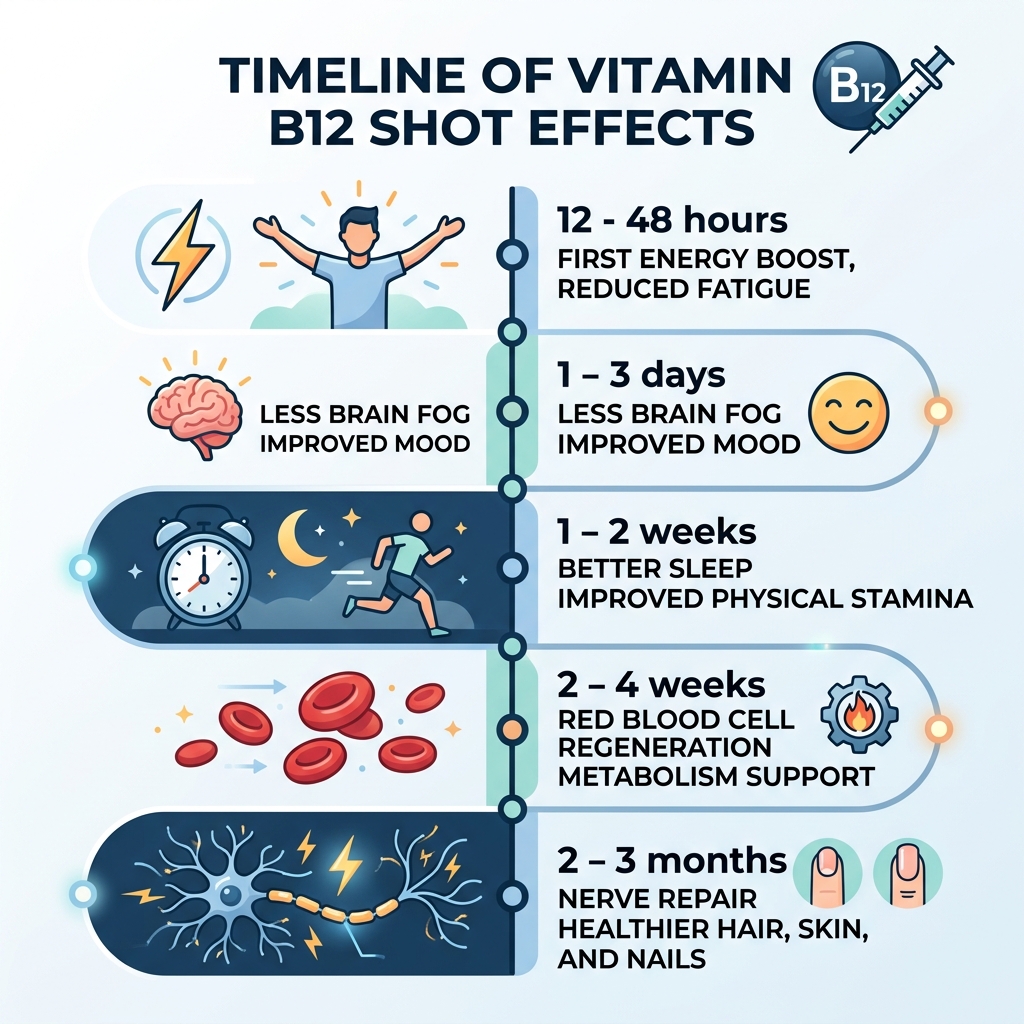
| Symptom / Outcome | What you might notice | Typical timeframe after starting B12 injections | Why the timing differs |
|---|---|---|---|
| General energy / fatigue | Less tiredness, more “get up and go” | Often days to 1–2 weeks | Better cellular function and oxygen utilization-related pathways can show early effects when deficiency is significant. |
| Mood / motivation / mental clarity | Improved focus, reduced “fog” | 1–3 weeks | Cognition and neurotransmitter-related effects may lag behind purely energetic changes. |
| Lab markers (B12, MMA, homocysteine) | Biochemical correction | 1–4+ weeks | Markers normalize at different rates; MMA often takes longer to improve. |
| Nerve symptoms (tingling, numbness, balance issues) | Slower, sometimes partial improvement | Weeks to months (sometimes longer) | Nerve remyelination and repair can’t happen overnight, especially if symptoms existed for a long time before treatment. |
Bottom line: Many people feel something in the first week or two, but the full benefit—especially for nerve symptoms—can take much longer. If you’re expecting instant results, you may get frustrated; if you track the right indicators, you can judge progress more accurately.
What affects how quickly B12 injections kick in
Two people can receive the same type of B12 shot and have very different timelines. Here are the biggest drivers I’ve seen in real-world cases.
1) How low your B12 was to begin with
If labs confirm significant deficiency, B12 is more likely to rapidly improve cellular processes tied to energy and red blood cell formation. Mild deficiency can feel slower and less dramatic.
2) The cause of your low B12
In my hands-on work, the underlying cause often explains whether shots feel like they “kick in fast” or only partially:
- Diet-related deficiency: symptoms may improve more predictably with supplementation.
- Absorption problems (e.g., pernicious anemia, certain GI conditions): injections bypass absorption issues, but you may still need ongoing treatment to maintain levels.
- Medication-related issues: if the cause persists, you may feel improvement but plateau unless the broader issue is managed.
3) Your shot schedule and dose
Different clinical regimens exist (loading schedules vs. maintenance). In practice, a more intensive initial schedule often accelerates correction, while maintenance-only schedules may improve symptoms more slowly. If you’re spacing shots too far apart early on, you might not experience the “fast kick-in” you expected.
4) Vitamin cofactors and overall nutrition
B12 doesn’t work in isolation. Folate, iron status, and overall nutrition can influence how quickly your body responds. I’ve seen cases where B12 started helping, but energy didn’t fully return because another deficiency limited red blood cell function and recovery.
5) Symptom type (energy vs. nerves)
Energy and cognitive symptoms can improve earlier than nerve symptoms. If you’re focused on tingling or numbness, aim for a longer timeline and track gradual changes rather than day-to-day swings.
Real-world example: what “noticeable” looked like for us
In one case I worked with, a patient started B12 injections after labs showed clear deficiency and they reported escalating fatigue and difficulty concentrating. By the end of the first week, they described “less drag” and better afternoon stamina. By week three, focus improved enough that they returned to a more demanding routine. However, they’d also had mild tingling for months, and that didn’t resolve quickly—this part shifted slowly over subsequent months.
This pattern—faster response for non-nerve symptoms and slower recovery for nerve-related issues—matches what I consistently see across similar situations.
How to tell whether your B12 shots are truly working
Waiting for symptoms alone can be misleading, so I recommend combining symptom tracking with objective measures.
Track symptoms in a structured way
- Rate fatigue and mental clarity daily (even a simple 1–10 scale).
- Note the timing of any improvements (e.g., “better within 48 hours” vs. “gradual improvement over 2 weeks”).
- If you have nerve symptoms, track functional changes (e.g., walking stability, hand dexterity), not just “tingling intensity.”
Ask about follow-up labs when appropriate
Common follow-up approaches include checking B12 levels and sometimes markers like MMA and homocysteine, depending on your clinician’s assessment and your starting results. The goal is not just “a number,” but biochemical correction consistent with clinical improvement.
Watch for red flags that need medical review
Seek prompt medical advice if you experience severe or worsening neurologic symptoms, significant weakness, confusion, or symptoms that don’t begin to improve after a reasonable window given your severity.
Common misconceptions about B12 injection speed
- “If it’s not instant, it’s not working.” Not true. Many people need time for red blood cell effects and nerve recovery, especially if symptoms have been present for months.
- “More frequent shots always mean faster results.” Sometimes schedules matter, but more is not always better—dosing and cause still matter.
- “Only B12 matters.” Folate, iron, and overall nutrition can influence recovery.
Product image (for reference)
FAQ
How long does b12 injection take to kick in for fatigue?
Many people notice improved energy within days to 1–2 weeks. If fatigue is primarily driven by another issue (like iron deficiency or sleep disruption), B12 may help but not fully resolve symptoms quickly.
How long until B12 shots help with tingling or numbness?
Nerve symptoms usually improve more slowly—often weeks to months. The longer nerve symptoms existed before treatment, the longer recovery can take.
What if I feel no improvement after the first couple of weeks?
It may still take time, but persistent lack of improvement should prompt reassessment. In my experience, clinicians typically revisit the diagnosis (including the cause of B12 deficiency), your injection schedule, and whether other nutritional factors (like folate/iron) or ongoing conditions are affecting results.
Conclusion: the practical takeaway
So, how long does b12 injection take to kick in? For many people, energy and mental clarity can start improving within days to 1–2 weeks, while nerve symptoms usually take weeks to months to change. Your timeline depends on how low your B12 was, why it was low, your dosing schedule, and which symptoms you’re targeting.
Next step: Start tracking your symptoms (simple daily 1–10 ratings for fatigue and focus) and ask your clinician about appropriate follow-up labs so you can judge whether you’re seeing real biochemical and clinical progress—not just waiting in the dark.
Discussion