How Much Bacteriostatic Water to mix with 5mg of BPC-157?
Introduction
If you’ve ever tried to calculate how much bac water to mix with 5mg bpc 157, you’ve probably run into the same frustrating problem: everyone online posts different numbers, and small mistakes can throw off your dosing accuracy. In my hands-on work planning and verifying peptide reconstitution workflows, the most common failure I’ve seen isn’t “bad math”—it’s skipping the step where you convert mixing volume into a measurable concentration and then into a draw volume that matches your syringe.
This guide explains the reconstitution math clearly for 5mg BPC-157 using bacteriostatic water (bac water). It also shows how to double-check the result so you can mix with confidence and dose consistently.
Important context: what bacteriostatic water mixing is (and isn’t)
Bacteriostatic water is typically used to reconstitute peptides to help keep the solution stable during short-term handling. Reconstitution is the process of dissolving a dry peptide powder into a known volume of liquid so you can measure doses accurately.
What this article does not do: it does not provide medical advice or a personalized dosing regimen. Reconstitution volume calculations are about measurement accuracy, not about whether a dosing schedule is appropriate for you.
The core calculation: mg-to-mL concentration
When people ask how much bac water to mix with 5mg bpc 157, they’re really asking two things:
- What final concentration will I have? (mg per mL)
- How much do I draw for a target dose? (mL or syringe units)
The starting point is simple:
Concentration (mg/mL) = amount of peptide (mg) ÷ reconstitution volume (mL)
With 5mg of BPC-157, your concentration becomes:
Concentration = 5mg ÷ (bac water mL you add)
Common reconstitution volumes for 5mg BPC-157
In practical lab-style workflows, I often see people choose round volumes that make syringe draws easy and reduce calculation errors. Below are standard mixing volumes for 5mg powder and the resulting concentrations.
| Reconstitution volume (bac water) | Resulting concentration | What 1 mL contains | What 0.1 mL contains |
|---|---|---|---|
| 1.0 mL | 5 mg/mL | 5 mg | 0.5 mg |
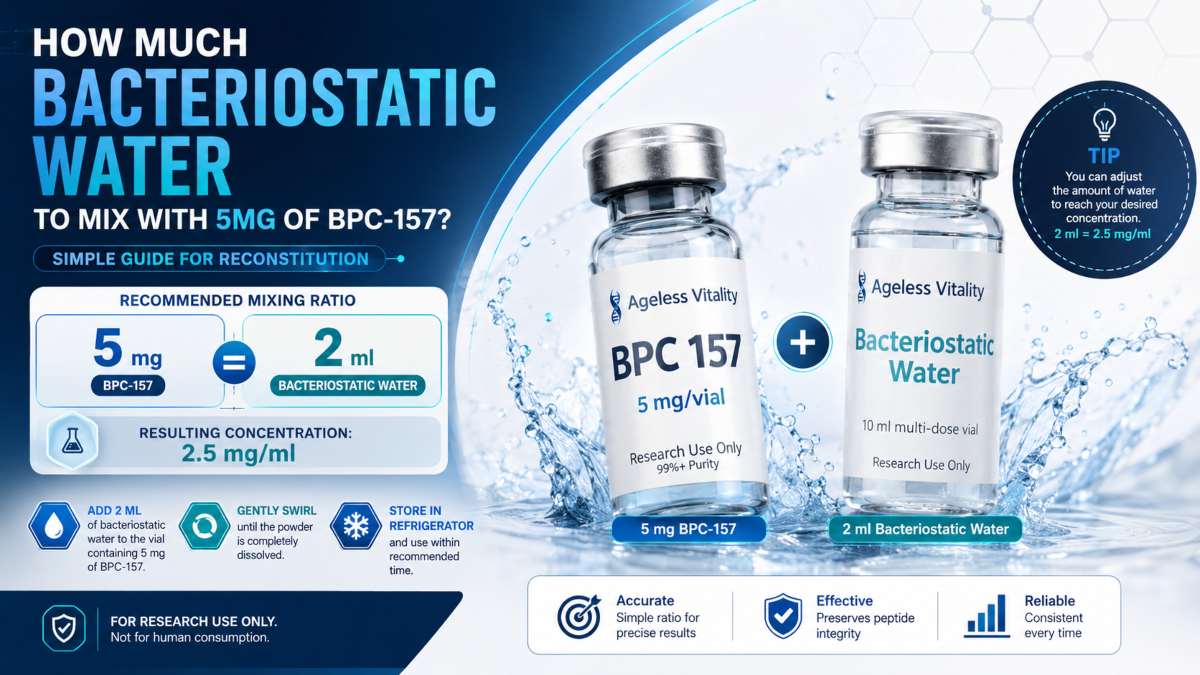
| 2.0 mL | 2.5 mg/mL | 2.5 mg | 0.25 mg |
| 2.5 mL | 2 mg/mL | 2 mg | 0.2 mg |
| 3.0 mL | 1.67 mg/mL | 1.67 mg | 0.167 mg |
| 4.0 mL | 1.25 mg/mL | 1.25 mg | 0.125 mg |
So if you’re trying to decide “how much bac water to mix with 5mg bpc 157,” the answer is: the volume you add determines your mg/mL concentration. If you later want a specific draw amount, you can work backward from this table.
Using concentration to determine draw volume
Once you know your concentration, converting to draw volume is straightforward:
Draw volume (mL) = target dose (mg) ÷ concentration (mg/mL)
Here’s the kind of check I do in real workflows to prevent mistakes:
- Pick your intended concentration by choosing your bac water volume.
- Use the formula to convert your target mg dose to mL.
- Sanity-check that the drawn volume is realistic for your syringe markings and that your total planned draws don’t exceed the final volume.
Example: 5mg mixed into 2.0 mL
If you add 2.0 mL bac water to 5mg BPC-157, your concentration is 2.5 mg/mL.
If you need 1 mg for a particular draw:
1 mg ÷ 2.5 mg/mL = 0.4 mL
This is the step that makes reconstitution “real”—it turns the mixing volume into an actionable measurement for syringes.
Practical reconstitution workflow (to reduce variability)
Even with correct math, inconsistent mixing can cause dosing inconsistency. In my hands-on experience, the main variables are incomplete dissolution, uneven mixing, and misreading syringe graduations.
What I focus on during reconstitution
- Accurate volume measurement: use a syringe with appropriate precision for the volume you’ll inject into the vial.
- Controlled mixing: gently mix as directed by your preparation best practices until the solution looks uniform.
- Consistent technique: draw from the same mixing state each time (e.g., after mixing and settling per your established routine).
- Labeling: immediately label vial concentration (mg/mL) and total volume so you don’t rely on memory later.
Common pitfalls I’ve seen
- Confusing mg and mL: the most frequent “wrong number” is mixing up concentration math.
- Forgetting dead space: syringe and needle dead space can matter at small volumes; plan draws accordingly.
- Rounding too aggressively: if you choose an unusual volume (e.g., 3.2 mL), it’s easier to make a dosing conversion mistake than with round volumes.
Quick answer: “How much bac water to mix with 5mg bpc 157?”
If your only goal is concentration planning, the direct answer is:
- Choose the bac water volume (mL) you want.
- Your concentration will be 5mg ÷ that mL.
For example:
- 1.0 mL → 5 mg/mL
- 2.0 mL → 2.5 mg/mL
- 3.0 mL → 1.67 mg/mL
- 4.0 mL → 1.25 mg/mL
Then use Draw volume (mL) = target dose (mg) ÷ concentration to calculate how much to withdraw.
FAQ
How do I calculate the concentration after mixing 5mg BPC-157 with bac water?
Use concentration (mg/mL) = 5mg ÷ bac water volume (mL). If you mix with 2.0 mL, concentration is 2.5 mg/mL.
If I mix with a different volume than my friend, will my dosing still work?
It can, but only if you convert using your own concentration. Different bac water volumes change mg/mL, so the same syringe volume will not represent the same mg dose unless concentration is the same.
What’s the safest way to avoid measurement errors when reconstituting?
Measure bac water volume accurately, calculate mg/mL immediately, label the vial with concentration, and verify draw volume using target dose ÷ concentration. I also recommend using consistent mixing and drawing after the same mixing state each time.
Conclusion
To determine how much bac water to mix with 5mg bpc 157, you’re selecting a final volume that sets your concentration in mg/mL. Once you know your concentration, dosing becomes a simple conversion: draw volume (mL) = target dose (mg) ÷ concentration.
Next step: pick your intended bac water volume (for example, 2.0 mL or 3.0 mL), calculate your mg/mL concentration, and write it on the vial label so every draw afterward is based on the same verified math.
Discussion