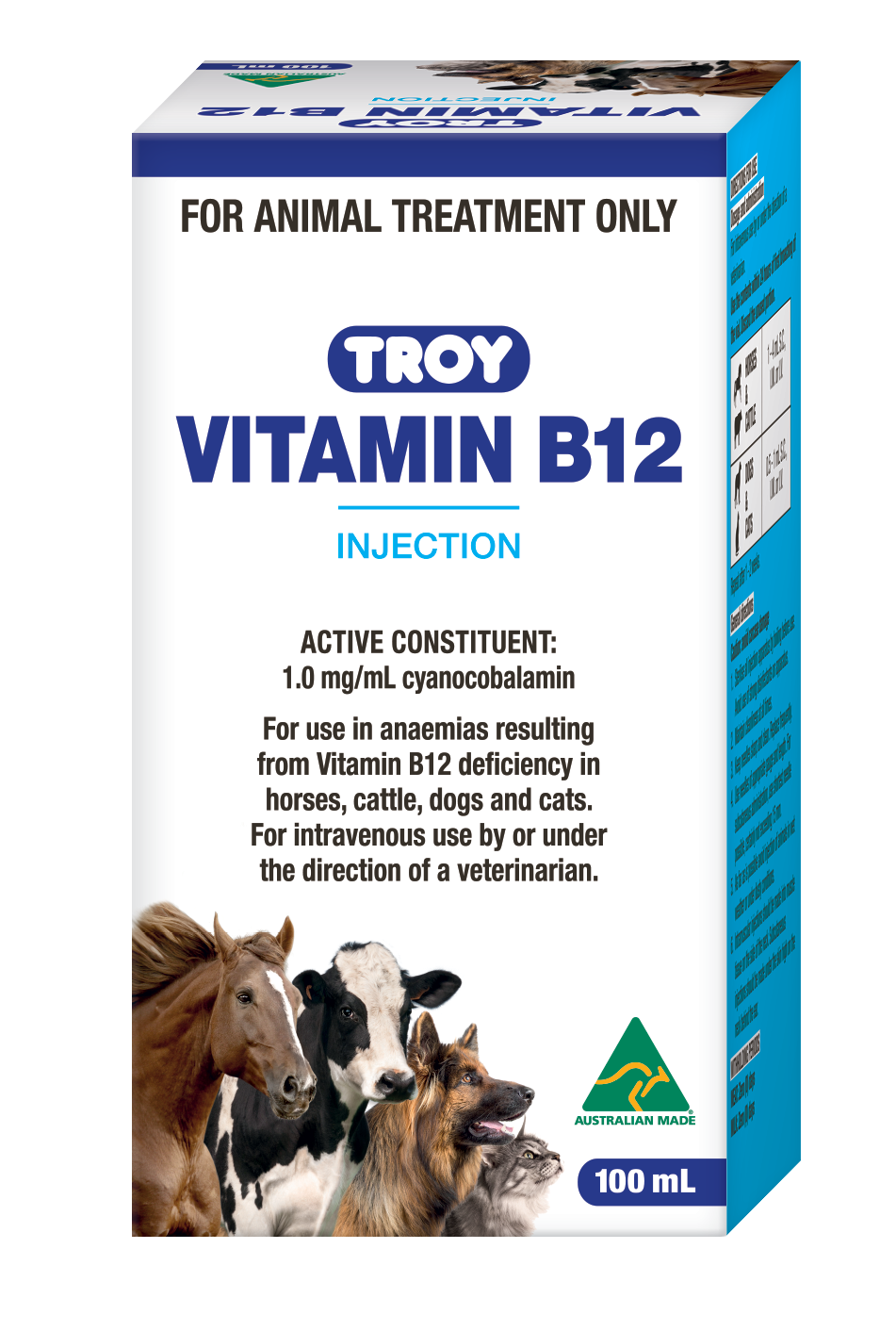
Troy Vitamin B12 Injection 100 mL
Trouble Maintaining Energy & Muscle in Your Horse? Let’s Talk B12 for Horses Injections
If your horse seems a little flat—less willing to work, slower recovery after sessions, or generally less consistent—it's easy to look at feed and training and miss a common nutritional lever: b12 for horses injections. In my hands-on work with performance and recovery plans, I’ve seen how quickly owners lose confidence when they don’t understand what Vitamin B12 can (and can’t) do, how injections are actually used, and what signals to watch for after starting a course.
This guide explains what Vitamin B12 injections are intended to support, how to think about dosing and timing in a practical horse-care workflow, and how to handle administration responsibly—using Troy Vitamin B12 Injection 100 mL as the example product for label-style considerations.
What Vitamin B12 Does for Horses (And Why Injection Is Sometimes Used)
Vitamin B12 (cobalamin) is part of the biochemical machinery that supports red blood cell production and helps maintain pathways involved in energy metabolism. In real-world barn settings, B12 is often discussed when horses have:
- Suboptimal condition despite reasonable feed intake
- Demand spikes (training blocks, show season, travel, recovery from illness)
- Periods where diet composition changes or appetite is inconsistent
- Workloads that highlight how quickly performance dips if nutritional support isn’t steady
Why injection? For some owners and veterinarians, injections are chosen for consistency of administration and to support a targeted approach during a specific recovery or performance window. In my experience, the biggest advantage isn’t “magic”—it’s that injection-based programs are easier to control and track compared with relying purely on variable intake (especially when appetite or gut comfort changes).
The limitation to understand upfront
B12 can’t replace foundational drivers like adequate calories, proper forage, correct protein levels, mineral balance (especially copper/iron interactions), and soundness management. If the underlying issue is inflammatory disease, parasitism, dental pain, or a chronic metabolic problem, a B12 program won’t be enough by itself. I’ve learned to treat B12 as a support tool, not a rescue solution.
How to Use Troy Vitamin B12 Injection 100 mL Safely and Responsibly
When using Troy Vitamin B12 Injection 100 mL in a plan that includes b12 for horses injections, the most important principle is to align with veterinary guidance and the product label directions for your horse’s situation. I can’t confirm dosing for an individual horse from a blog post, but I can walk you through the practical decision points owners typically need.
Administration workflow I recommend in real barn practice
- Start with the reason: energy drop, recovery planning, or a diet transition period. Write down the “problem” in observable terms (work rate, appetite, coat condition, recovery time).
- Coordinate with your veterinarian: confirm whether B12 is appropriate and whether any bloodwork or checks are needed based on the symptoms.
- Match the product to the plan: Troy Vitamin B12 Injection 100 mL is a large-volume pack intended for use across multiple administrations—so plan inventory and storage habits to avoid unnecessary waste.
- Follow label directions: route, handling, and dosing schedule should follow the approved product instructions (and veterinary direction where applicable).
- Track response: reassess within the expected timeframe for your plan (often within days for some practical markers, longer for condition changes).
What to monitor after starting B12 injections
To keep this honest and useful, I focus on measurable barn observations:
- Work tolerance: can the horse complete the same set without unusual fatigue?
- Recovery quality: heart rate returns faster, fewer “off” moments the next day, smoother cool-down.
- Appetite stability: does the horse maintain intake during the injection window?
- Behavioral consistency: fewer signs of lethargy or low motivation for routine sessions.
If these markers don’t move as expected, I’ve learned it’s usually a sign to revisit the broader nutrition and health picture—not to simply extend injections indefinitely.
Common Mistakes With B12 for Horses Injections (And How to Avoid Them)
Over years of supporting owners and trainers, I’ve repeatedly seen the same errors. These are the ones that most often turn a reasonable plan into a confusing outcome.
1) Treating B12 as the only variable
Changing one input while holding everything else constant is hard, but it’s essential for interpreting results. If you start B12 and also change forage type, grain, supplement brands, or training intensity, you can’t confidently attribute any improvement.
2) Skipping documentation
I keep a simple log: date, product used, administration schedule, and what changed in the horse’s routine. It only takes a few minutes and prevents “memory drift” when you’re comparing outcomes.
3) Delayed response to red flags
If your horse shows signs like fever, severe weight loss, persistent diarrhea, abnormal gum color, colic symptoms, or marked weakness, those are not B12 situations. Those are veterinary issues first.
4) Improper storage and handling
Injection programs can fail quietly if the product is mishandled. Follow storage instructions on the label, and keep administration hygiene consistent. I’ve seen preventable issues from rushed setups and inconsistent needle/technique discipline.
FAQ
Is b12 for horses injections safe for all horses?
Not necessarily. Safety depends on the individual horse, underlying health conditions, and correct administration per the product label and veterinary advice. If a horse has unexplained weakness, illness signs, or significant metabolic issues, you should involve your veterinarian before starting injections.
How quickly should I expect changes after starting Vitamin B12?
Some owners notice practical improvements in energy and work tolerance within days, especially when the issue is diet consistency or recovery support. However, deeper condition or performance shifts can take longer, and lack of improvement should trigger a re-check of the overall nutrition/health plan—not automatic extension.
Can I replace diet and supplements with b12 for horses injections?
No. Vitamin B12 injections are supportive, not a replacement for core nutrition (forage quality, adequate calories, protein, and mineral balance). In my experience, the best results come when B12 is layered onto a solid feeding and health-management baseline.
Conclusion: Use B12 as a Targeted Support Tool, Not a Guessing Game
B12 injections can be a useful part of a structured recovery or performance support plan, especially when you’re using b12 for horses injections to maintain consistency during demand spikes or nutritional disruptions. The key is to pair injections with clear goals, correct label-aligned administration, and honest monitoring of measurable response.
Next step: Write a one-page plan for your horse—current workload, current feed/supplement list, the specific reason B12 is being considered, and what you’ll measure over the first week—then confirm the injection schedule with your veterinarian using the product label directions.
Discussion