Vitamin B12 Injection Sites: All You Need to Know
Vitamin B12 Injection Sites: All You Need to Know
If you’ve ever wondered whether you’re choosing the right injection site—or whether you can safely learn how to give a b12 injection in the buttocks—you’re not alone. I’ve worked with clinicians and home-care teams where the same problem keeps showing up: people underestimate how much technique and site selection affect comfort, absorption, and risk.
This guide walks you through the practical realities of common vitamin B12 injection sites, what makes the buttocks a typical choice, and how to approach instructions responsibly. You’ll also find an FAQ that addresses the questions I most often hear when patients or caregivers are preparing for an at-home schedule.
Why Injection Site Matters for B12
Vitamin B12 injections are typically given as an intramuscular (IM) shot when oral options aren’t preferred or when rapid correction is needed. With IM injections, the goal is to deposit medication deep into muscle tissue so it can be absorbed consistently.
From my hands-on experience, the “site matters” part isn’t theoretical:
- Absorption and consistency: Using the intended muscle helps the medication enter circulation predictably.
- Pain and tissue irritation: Wrong or inconsistent placement can increase discomfort and bruising.
- Safety: Specific anatomy reduces the risk of hitting nerves and blood vessels.
That’s why “where” matters as much as “how.” Even if the needle and medication are correct, an incorrect site can change the entire outcome.
Common Vitamin B12 Injection Sites (And When They’re Used)
In practice, vitamin B12 is often administered at one of a few IM sites. Your prescriber’s instructions should be your primary source, but understanding the options helps you ask better questions during training.
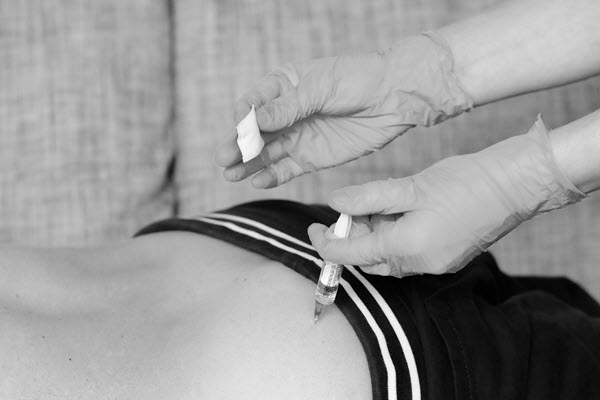
1) Buttocks (Upper Outer Quadrant)
The buttocks are a classic IM site for B12. The key is landmarking the upper outer quadrant to avoid major nerves.
- Why it’s used: Generally large, accessible muscle mass for IM delivery.
- What to focus on: Correct location within the buttock—not centered randomly.
- Common issue I’ve seen: Caregivers placing the needle too low or too medial because they “aim at the middle.” That’s not the same as selecting the correct quadrant.
2) Upper Arm (Deltoid)
The deltoid can be used for some IM injections, but technique and volume suitability matter.
- When it’s appropriate: Often for smaller injection volumes and selected regimens.
- What to focus on: Palpating the muscle and maintaining correct depth.
In my experience, deltoid is frequently chosen for ease of access, but if the prescribed volume is larger or the clinician advises a deeper muscle, the buttocks may be the safer default.
3) Outer Thigh (Vastus Lateralis)
The outer thigh is another IM option that some patients can learn more easily.
- When it’s appropriate: Useful for at-home administration for many people.
- What to focus on: Correct muscle targeting and consistent technique.
If you’re rotating sites (common in longer treatment courses), your clinician may specify a rotation pattern to minimize soreness and repeated irritation.
How to Give a B12 Injection in the Buttocks (Site Selection and Technique)
Because injection technique carries real medical risk if done incorrectly, I’m going to focus on the decision-making and landmarking that matter most—along with the practical lessons I’ve learned from training sessions—rather than offering step-by-step needle instructions.
Your prescriber or nurse should teach you the exact procedure for your specific B12 product, needle gauge/length, and injection volume.
Step 1: Confirm the Right Medication and Supplies
- Verify the exact B12 product, dose, and route (IM vs. another route).
- Use only the syringe/needle type your clinician provided.
- Check the medication label and ensure the vial isn’t expired or improperly stored.
I’ve seen delays and missed doses happen when people prepared the “right idea” but used the wrong syringe type or couldn’t match the needle length to the muscle depth of their body.
Step 2: Choose the Correct Buttocks Region (Upper Outer Quadrant)
The core concept behind how to give a b12 injection in the buttocks is selecting the upper outer quadrant. This reduces the likelihood of injuring the sciatic nerve, which runs through the lower, more central portions of the buttock.
In training, I use a simple consistency checklist:
- Upper: It’s not the lowest part of the buttock.
- Outer: It’s more toward the side than toward the center.
- Quadrant, not “spot guessing”: Avoid aiming at the middle or at a visible bruise/painful area.
Step 3: Prepare the Skin and Positioning
Skin prep and positioning affect both comfort and accuracy.
- Follow your clinician’s skin-cleaning guidance using appropriate antiseptic and technique.
- Position the person so the buttock muscle is relaxed and accessible.
- Use a consistent approach to reduce anxiety—people tense up when they feel uncertain, which can make landmarking harder.
Step 4: Rotate Sites and Watch for Reactions
Even when the site is correct, soreness can happen. Rotating injection sites is a practical way to reduce repeated irritation.
Be alert for:
- Persistent or worsening pain at the injection site
- Signs of infection (increasing redness, warmth, swelling, fever)
- Allergic symptoms (e.g., rash, swelling, trouble breathing—seek urgent care)
- Unusual numbness or radiating pain (a reason to stop and contact a clinician immediately)
In one case I supported, repeated injections at the same exact spot caused significant bruising. Once the caregiver rotated the buttock region and used the taught landmarking, the pattern of bruising improved within a couple of weeks.
Step 5: Know When Not to Self-Administer
Don’t improvise if:
- You were never formally taught by a nurse or clinician for your exact product and supplies.
- You can’t reliably identify the upper outer quadrant.
- The person has significant changes in anatomy, scarring, severe pain, or mobility limits.
- You’re dealing with symptoms that may indicate complications.
In my work, the most successful at-home injection plans weren’t the ones that “learned from videos.” They were the ones where technique was practiced under supervision until placement felt consistent.
Common Mistakes People Make With Buttock B12 Injections
These are the errors I’ve most often seen in caregiving settings:
- Wrong quadrant: Placing the injection too low, too central, or too close to the seam between the buttocks.
- Inconsistent landmarks: Changing where “upper outer” is each time rather than using the same mental map.
- Injecting into irritated skin: Avoiding the planned site because it looks bruised, but then picking a new random spot instead of rotating systematically.
- Skipping clinical guidance: Assuming all IM shots are identical despite differences in needle length, medication concentration, and patient factors.
- Not rotating: Leading to repeated soreness and more frequent bruising over time.
If you want the best odds of success, treat injection practice as a skill—something you should be taught and then reinforced.
FAQ
Can I give a B12 injection in the buttocks at home?
It can be appropriate, but only if your clinician confirms the route (IM) and teaches you the technique for your specific B12 product, dose, and needle size. If you can’t reliably identify the upper outer quadrant or you notice concerning symptoms, seek training or avoid self-administration.
What should I do if I hit a nerve or feel sharp radiating pain?
Stop and contact a clinician promptly. Sharp, radiating pain, numbness, or weakness afterward can indicate nerve involvement and needs medical guidance rather than repeating the injection.
How do I reduce bruising after B12 injections?
Use consistent landmarking (upper outer quadrant), rotate injection sites as advised, and avoid injecting into highly irritated or bruised areas. If bruising is severe or persistent, ask your clinician to reassess technique, needle length, and injection approach.
Conclusion
Choosing the right vitamin B12 injection site isn’t just about convenience—it’s about consistent IM delivery, comfort, and safety. The buttocks (using the upper outer quadrant approach) are commonly used, but success depends on correct landmarking, consistent technique, and attention to how your body responds after each shot.
Next step: Ask your nurse or prescriber for a supervised “teach-back” session where you demonstrate how to select the upper outer quadrant for how to give a b12 injection in the buttocks using your exact needle and supplies. That single confirmation is usually what turns uncertainty into confidence.
Discussion