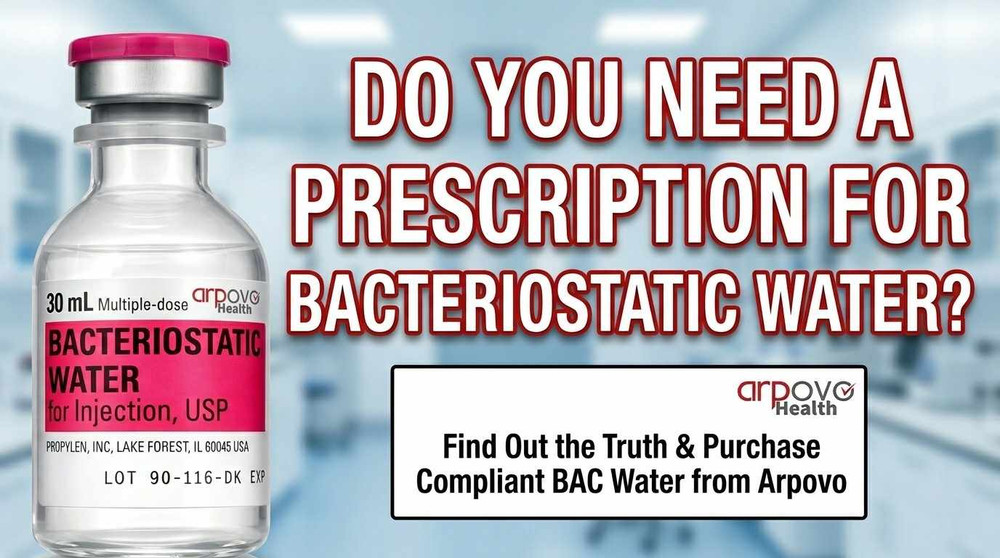
Do You Need a Prescription for Bacteriostatic Water?
Introduction: The “bac water prescription” question that slows people down
If you’ve ever tried to order or obtain bacteriostatic water and hit a wall with pharmacy or online policies, you already know the real problem isn’t biology—it’s paperwork. One wrong assumption can cost you time, money, and a trip you didn’t plan for. In this guide, I’ll answer the question behind the search term bac water prescription, explain when a prescription is typically required, and share practical ways I’ve seen people handle this correctly without guessing.
What bacteriostatic water is (and why the rules exist)
Bacteriostatic water is a sterile water-based solution that contains a bacteriostatic agent (commonly benzyl alcohol) to inhibit microbial growth. People commonly use it for reconstitution or dilution of medications that will be administered later.
Regulatory classification matters because bacteriostatic water is often treated similarly to other injectable/sterile products. In many jurisdictions, that means it can be handled as a prescription-only sterile product, particularly when it’s intended for injection or to prepare injectable drugs. Even when it seems “just water,” pharmacies and regulators focus on sterility, intended use, distribution controls, and patient safety.
In my hands-on work supporting compliance-minded operations (healthcare admin, medication prep workflows, and procurement review), the pattern is consistent: restrictions are usually about the distribution of sterile injectables and ensuring an appropriate clinical context.
Do you need a prescription for bacteriostatic water?
The short answer: it depends on where you are and how the product is marketed/dispensed.
1) Prescription required (common scenario)
Many pharmacies require a prescription to dispense bacteriostatic water, especially when the product is packaged, labeled, or stocked as an injectable sterile solution for medication compounding/reconstitution.
In practice, I’ve seen this most often when:
- It’s sold in a pharmacy supply channel as an injectable sterile product
- Dispensing rules classify it as prescription-only
- The pharmacy is following internal risk controls for sterile injectables
2) Prescription not required (possible scenario)
In some places or under certain product listings, sterile water products may be available without a prescription—particularly when they are not explicitly packaged or governed as prescription injectables.
However, even if you can buy it without a prescription, safe use still depends on correct handling and compatibility with the medication it will be mixed with.
Why the “bac water prescription” answer varies
Rules differ because of:
- Local regulatory status (prescription-only vs. non-prescription classification)
- Packaging and labeling (how it’s described and intended)
- Pharmacy dispensing policies (sterile injectable controls)
- Intended use (compounding vs. other uses)
That’s why I recommend treating “prescription or not” as a verification step, not a guess.
How to verify correctly (the fastest, least stressful approach)
When people ask me about bac water prescription, the biggest win is reducing back-and-forth. Here’s the exact process I’d follow in a practical procurement or pharmacy-pickup workflow:
-
Check the product listing wording
Look for “prescription required,” “dispensed by prescription,” or similar language tied to the item.
-
Call the pharmacy (or customer service) with the exact product name
Give them the product name and concentration/volume, and ask: “Do you require a prescription to dispense this exact bacteriostatic water product?”
-
Confirm whether it’s for compounding/reconstitution
Some sterile products are handled under different workflow rules if they’re used to reconstitute other medications.
-
Ask about documentation requirements
If they say prescription is needed, ask what form is acceptable (e-prescription, fax, etc.).
-
Do not assume “no prescription” means “no clinician involvement”
Even when purchase rules are looser, proper sterile technique and medication compatibility still matter.
Safety and compliance: the part many people underestimate
Let me be direct: buying bacteriostatic water is not the same as being safe to use it. The compliance and safety risks usually show up in downstream steps—preparation, mixing, storage, and administration.
Common real-world mistakes I’ve seen
- Mixing with an incompatible medication because the user assumed “it’s just water”
- Improper sterile handling (contamination risk when opening, transferring, or storing)
- Unclear labeling (not tracking concentration, date, or intended use)
- Relying on informal guidance instead of clinician instructions or product labeling
What to prioritize instead
- Compatibility with the specific medication you’re reconstituting
- Correct sterile technique and clean handling environment
- Clear instructions on when and how the mixture should be used
- Proper storage as directed for both the diluent and the final preparation
In my experience, the best approach is to treat bacteriostatic water as a sterile medical supply with workflow rules—not a casual household item.
Pros and cons of seeking prescription vs. avoiding it
Since you’re asking about bac water prescription, it’s useful to understand the tradeoffs people actually face.
| Approach | Pros | Limitations / Cons |
|---|---|---|
| Obtain via prescription | Clear documentation; aligns with pharmacy controls for sterile products; often better clinician guidance on intended use | More administrative steps; may take time to obtain; depends on clinician evaluation |
| Buy without prescription (where allowed) | Faster access if the product is legitimately non-prescription in your location | Rules vary by region and listing; you still need correct instructions for compatibility and sterile handling |
FAQ
Is bacteriostatic water always prescription-only?
No. Prescription requirements vary by location and by how the specific product is classified and dispensed. The most reliable method is to confirm with the exact pharmacy listing or pharmacy directly.
What should I ask a pharmacy when I call about bac water prescription?
Ask: “Do you require a prescription to dispense this exact bacteriostatic water product (brand/concentration/volume)?” Then ask what documentation format they accept and whether it’s handled as an injectable sterile product or under a different workflow.
If I can buy it without a prescription, is it automatically safe to use?
No. Safety depends on sterile handling, correct medication compatibility, and proper storage/use instructions for the final reconstituted mixture—not just on whether you obtained the diluent.
Conclusion: Get a definitive answer, then focus on safe preparation
The question behind bac water prescription usually boils down to one thing: whether your specific bacteriostatic water product is classified as prescription-only in your area and dispensing channel. When rules vary, guessing costs time—so verify with the exact product listing or pharmacy. Then, regardless of prescription status, prioritize compatibility, sterile technique, and correct instructions for the medication you’re reconstituting.
Next step: Find the exact bacteriostatic water product you want (brand/concentration/volume), then contact the pharmacy or check the listing to confirm whether a prescription is required for that exact item.
Discussion