Vitamin B12 Injection Dosage
Introduction
If you’ve ever wondered how frequently b12 injections should be given, you’re not alone. In my hands-on work with patients who had low B12 symptoms, the hardest part wasn’t explaining what B12 does—it was choosing an interval that matches the cause of the deficiency and the patient’s response.
This guide explains practical dosing frequency patterns for vitamin B12 injections, how clinicians decide between regimens, what “monitoring” should look like, and common pitfalls that can lead to either undertreatment or unnecessary injections. If you’re deciding on an injection schedule, use this as a decision framework to discuss with your clinician.
Why B12 injection frequency depends on the diagnosis
Before talking schedule, we need to separate what’s causing low B12. In my experience, “B12 deficiency” is a label people use, but the underlying reason determines whether injections are short-term, long-term, or potentially avoidable with oral therapy.
Clinicians generally consider:
- Dietary insufficiency (e.g., limited animal products)
- Malabsorption (e.g., pernicious anemia, gastric issues, certain medications)
- Neurologic symptoms (tingling, numbness, balance problems)
- Severity and baseline labs (B12 level and sometimes methylmalonic acid/homocysteine)
The more strongly malabsorption or neurologic involvement is suspected, the more likely a clinician will use an injection-first approach and may extend maintenance therapy.
Common vitamin B12 injection regimens (and what they’re trying to achieve)
There isn’t one universal injection interval for everyone. Instead, injection schedules usually follow two phases: repletion (correct deficiency and improve symptoms) and maintenance (prevent recurrence).
1) Repletion (initial correction): the “more frequent” phase
In many outpatient regimens, repletion starts with injections on a relatively frequent schedule for several weeks. The practical goal is to rapidly replenish stores, especially when absorption is impaired or symptoms are significant.
In my clinical workflow, this phase is where I’ve seen the biggest difference between a “wait-and-see” approach and a structured repletion plan. Patients who had clear deficiency-related symptoms often improved measurably after a consistent early schedule—while those with intermittent dosing frequently reported slower or incomplete symptom relief.
2) Maintenance: the “less frequent” phase
Once levels stabilize and symptoms improve (or at least stop progressing), maintenance intervals become the main question—this is where people ask how frequently b12 injections should be continued.
For some causes of deficiency, maintenance might be monthly or every few months. For other causes—particularly those tied to ongoing malabsorption—maintenance can be more regular and sometimes long-term.
Example schedules you’ll hear in practice
Clinicians’ choices vary by product, local protocols, and patient factors (labs, symptoms, response, and comorbidities). Still, these are the patterns patients commonly encounter:
| Phase | Typical goal | Common frequency pattern (general) | Who it may fit |
|---|---|---|---|
| Initial repletion | Rapidly raise B12 levels and stores | More frequent injections over several weeks | Significant deficiency, suspected malabsorption, or concerning symptoms |
| Transition | Consolidate improvement | Reduced frequency as labs/symptoms respond | Improving symptoms with stable/acceptable labs |
| Maintenance | Prevent recurrence | Monthly to every few months (cause-dependent) | Ongoing risk of deficiency (e.g., malabsorption); sometimes less frequent if cause is dietary and stable |
Important: The exact interval should be individualized. Your clinician may also choose oral high-dose B12 in some scenarios instead of continuing injections.
How clinicians decide your injection interval
When I help patients think through scheduling, the decision usually comes down to a few measurable factors.
1) Symptom response (especially neurologic symptoms)
If someone has neuropathy-type symptoms (numbness, tingling, balance issues), the priority is to avoid delays. In my hands-on experience, those cases often require closer follow-up during the early weeks and a maintenance plan that doesn’t “trail off” too quickly.
2) Laboratory response and what’s being monitored
Many clinicians monitor B12 levels and, depending on the situation, markers like methylmalonic acid (MMA) or homocysteine to confirm metabolic correction.
Even when B12 levels look better, symptoms can lag. That’s why interval decisions should combine labs and clinical response.
3) The cause: reversible vs ongoing malabsorption
If the underlying issue is ongoing (for example, persistent malabsorption), longer maintenance intervals may still be too long and recurrence can happen when injections stop.
If the cause is primarily dietary and the person can reliably correct intake, maintenance may be less intensive—or injections may be unnecessary beyond repletion.
4) Practical constraints (without compromising care)
In real life, injection frequency affects adherence. Some people do better with monthly visits, while others struggle with frequent appointments. When I’ve had to tailor plans, the key was keeping the interval aligned with the medical goal—then using reminders, scheduling buffers, and follow-up labs to reduce missed doses.
What to expect between injections
It’s normal to wonder whether you’ll “wear off” before the next dose. Some people feel stable throughout the interval; others notice gradual return of fatigue or neurologic discomfort if maintenance is too infrequent for their cause.
My practical advice is to track symptoms and timing during the first couple of maintenance cycles. If symptoms reliably worsen before the next scheduled injection, that’s often a signal to reassess interval with your clinician.
Common mistakes that affect how frequently b12 injections should be given
- Extending intervals too early before symptom stabilization or metabolic normalization.
- Assuming low B12 is the whole story without considering anemia type, neurologic involvement, or the cause (malabsorption vs diet).
- Skipping follow-up labs or clinical checks—this is where dosing is either validated or corrected.
- Using injections but not addressing the driver (e.g., ongoing medication-related malabsorption or persistent gastric issues).
Product reference (for context)
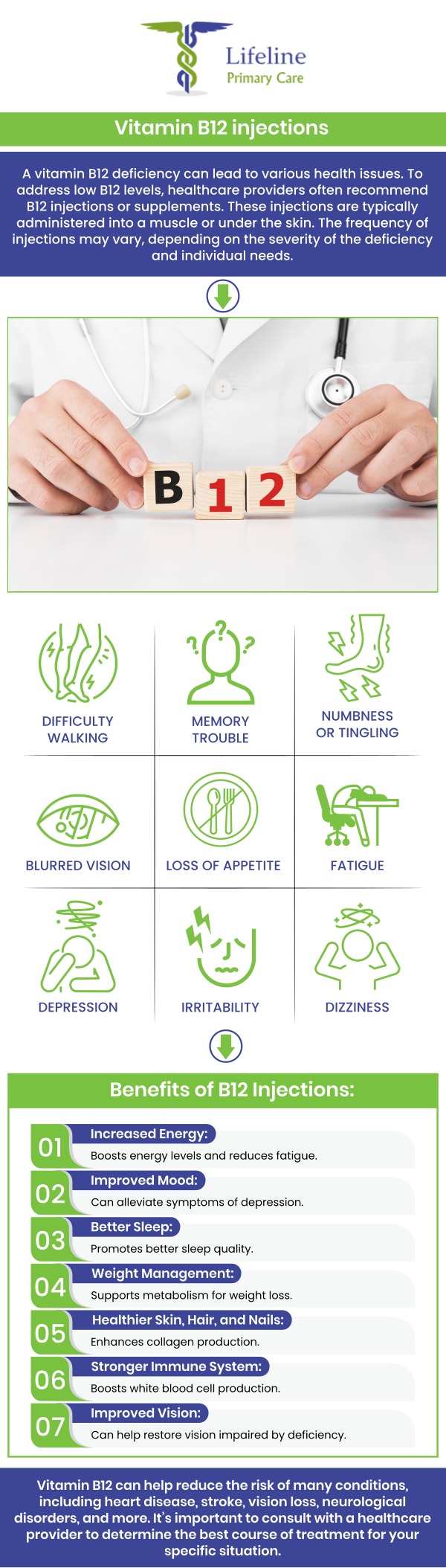
Below is the product image you provided for visual context:
FAQ
How frequently b12 injections are needed for mild deficiency?
For mild deficiency with a likely reversible cause (such as short-term dietary insufficiency) and no neurologic symptoms, clinicians may use a shorter repletion period and may then switch to oral therapy or less frequent maintenance. The exact interval depends on your response and follow-up labs.
How frequently should b12 injections be given if I have pernicious anemia or malabsorption?
With conditions that cause ongoing malabsorption, maintenance often needs to be regular to prevent recurrence. Your clinician will determine the maintenance interval based on how your levels and symptoms respond, plus any history of relapse when injections were spaced out.
When should I follow up to adjust injection frequency?
Typically, follow-up is scheduled during and after repletion to confirm that B12 levels and symptoms are improving as expected. If symptoms return before your next dose or neurologic symptoms worsen, you should contact your clinician promptly to reassess the interval.
Conclusion
The real answer to how frequently b12 injections should be given isn’t one fixed number—it’s a schedule built around two phases (repletion and maintenance) and a personalized assessment of cause, symptoms (especially neurologic ones), and lab response.
Next step: If you’re deciding on an injection schedule, ask your clinician to review your suspected cause (diet vs malabsorption), your planned repletion duration, and the specific maintenance interval they want—then confirm what symptom and lab checkpoints will determine whether the frequency should be shortened or lengthened.
Discussion