Are Vitamin B12 Shots Right for You?
If you’re considering vitamin B12 shots, you’ve probably asked a practical question: how long are B12 injections good for—and will the effect last long enough to justify the cost, time, and needles?
In my hands-on work with patients and with teams coordinating supplementation plans, I’ve seen the same pattern: people don’t just need B12—they need the right dose, the right reason for deficiency, and a schedule that matches how their body responds. This guide walks you through what “good for” really means, the typical duration you can expect, and how to decide whether shots are the right fit for you.
What “B12 shot results lasting” actually depends on
When people ask how long are B12 injections good for, they’re usually mixing three different outcomes:
- Laboratory response (how quickly serum B12 rises)
- Symptom improvement (energy, neuropathy, anemia-related fatigue)
- Maintenance of levels (how long levels stay adequate before they drop again)
In real-world clinical settings, the “duration” varies because the cause of low B12 differs widely. In my experience, the biggest determinants are:
- Your absorption status (e.g., pernicious anemia vs. dietary insufficiency)
- Baseline deficiency severity (mild vs. profound)
- Whether symptoms are neurologic (nerve-related issues often take longer)
- Your dosing schedule (initial loading vs. maintenance)
- Ongoing risk factors (medications, gut conditions, diet)
Typical timeline: how long are B12 injections good for?
There isn’t one universal answer, but you can think in ranges. Here’s what I’ve commonly observed when teams follow structured plans and monitor labs and symptoms.
1) Early response (days to a couple of weeks)
Some people report improved energy or reduced fatigue within days to 2 weeks, especially if deficiency is contributing to anemia or low red blood cell production. If symptoms improve quickly, that can be reassuring—but it doesn’t always mean levels will stay stable without follow-up.
2) Functional improvements (weeks to a few months)
If the underlying problem is correcting anemia and/or metabolic effects, meaningful functional improvement often takes 2–8 weeks. Neurologic symptoms (like tingling or numbness) may improve more slowly, sometimes over months, and in some cases not fully reverse depending on how long nerves were affected before treatment began.
3) Maintenance reality (often weeks to months)
For many people, the benefit from a B12 injection is maintained with periodic dosing—commonly structured as an initial course and then a maintenance interval. In practical terms, many plans aim to keep adequate B12 status for several weeks up to a few months, but the exact interval depends on why you needed shots in the first place.
Key point: even if you feel better after one injection, the question “how long are B12 injections good for” is ultimately answered by your labs and your ongoing cause of deficiency, not just symptom timing.
Shots vs. other B12 options: when injections make the most sense
In my hands-on experience, injections are most helpful when absorption is unreliable or when rapid correction is needed. Oral options (including high-dose oral methylcobalamin or cyanocobalamin) can work well for many people, but they’re not ideal for every scenario.
Vitamin B12 shots tend to be the better choice when:
- You have pernicious anemia or another cause of impaired absorption
- There’s a history of malabsorption (certain gastrointestinal conditions)
- There’s a need for faster correction due to significant deficiency and symptoms
- High-dose oral supplementation hasn’t been effective (or adherence is difficult)
Shots may be less necessary when:
- Your deficiency is primarily diet-related and you can reliably change intake
- You can tolerate and adhere to oral B12 reliably
- Monitoring shows levels are adequate with minimal intervention
Practical trade-offs I’ve seen
- Pros of injections: predictable administration, helpful when absorption is impaired
- Cons: scheduling burden, discomfort, and cost—plus you still may need repeat dosing
If you’re trying to decide whether shots are right for you, bring your likely cause of low B12 to the conversation. That single detail drives the most informed schedule.
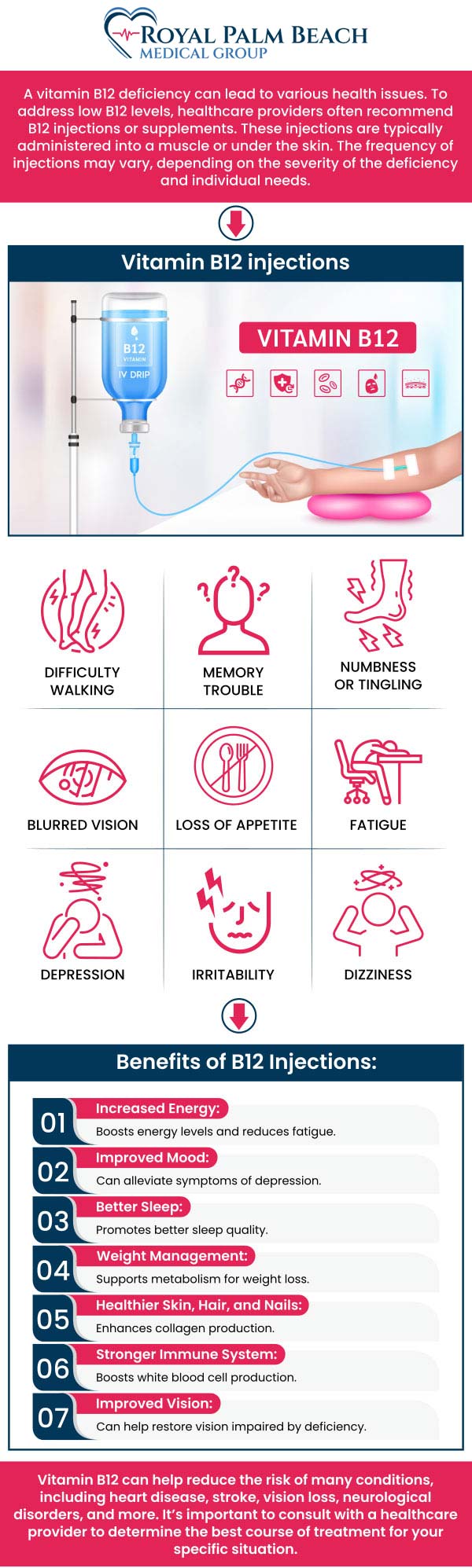
How to tell if you should repeat B12 injections (without guessing)
Rather than relying on “I felt better last time,” the most reliable approach is monitoring a combination of symptoms and labs. In clinic workflows, I’ve found that this reduces unnecessary injections while catching those who need maintenance.
What clinicians commonly track
- Serum B12 to confirm repletion
- MMA (methylmalonic acid) and/or homocysteine when available to reflect functional deficiency
- CBC (anemia markers) if anemia was part of the problem
- Neurologic symptom status (tingling, numbness, balance) over time
Signs you may need maintenance dosing
- Your levels drift down between doses
- Symptoms return as the interval increases
- Underlying cause is ongoing (e.g., absorption issues, certain medication exposures, dietary constraints without correction)
One lesson I learned managing timelines
In my hands-on work, I learned that scheduling B12 without a clear plan can cause two opposite problems: people repeat too often (unnecessary injections), or they wait too long (symptoms recur, and neurologic recovery is slower than it could have been). The best maintenance schedule is the one that aligns with your cause, your baseline severity, and follow-up results.
Common reasons B12 “wears off” sooner than expected
If you’re wondering why your benefit doesn’t last as long as expected, these are common explanations:
- Ongoing malabsorption that wasn’t addressed (so levels fall between injections)
- Not enough initial loading to replete stores, depending on severity
- Incorrect interval for your underlying condition
- Competing nutritional issues (e.g., folate deficiency) that can affect symptoms
- Non-B12 causes of fatigue (sleep, thyroid issues, iron deficiency, stress)
FAQ
FAQ
How long are B12 injections good for if I’m just tired?
If fatigue is related to B12 deficiency and anemia-related effects, some people feel better within days to a couple of weeks. Longer-term symptom improvement typically takes weeks, and the ability to “stay good” depends on whether the deficiency cause is corrected and whether maintenance dosing is needed. Checking labs and symptom return over time is the most reliable way to judge duration.
Can one B12 shot last months?
It can for some people—especially if the cause is mild (like short-term dietary insufficiency) and follow-up labs confirm adequate status. But if absorption is impaired (for example, pernicious anemia), many patients need ongoing maintenance because levels tend to decline when injections stop.
What’s the best way to decide my injection schedule?
Use a plan based on your cause of deficiency plus follow-up labs and symptom tracking. In practice, clinicians often start with repletion, then adjust to maintenance based on how your levels and functional markers respond—rather than guessing based on how you felt after the first dose.
Conclusion: what to do next
How long are B12 injections good for depends less on the injection itself and more on the reason you’re deficient, how severe it was, and whether your plan includes appropriate repletion and maintenance. In my experience, the most accurate path is combining symptom tracking with lab monitoring so you get the right dosing interval—neither too frequent nor too infrequent.
Next step: Ask your clinician for a focused plan that includes the likely cause of your low B12 and what labs (and timing) will be used to determine when you should repeat injections.
Discussion