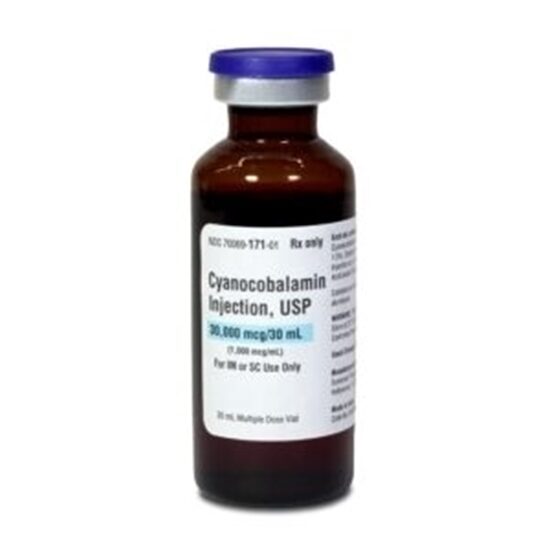
Cyanocobalamin (B12) Injection 1000 mcg/mL, Multiple Dose Vial 30 mL
Introduction
If you’ve ever had to calculate b12 injection dosing while juggling lab values, a patient’s diet history, and the realities of office workflows, you already know it’s not “one-size-fits-all.” In my hands-on work managing treatment plans alongside clinicians, the biggest pain point isn’t finding information—it’s turning a prescription into a safe, repeatable dosing schedule that matches the underlying cause of B12 deficiency.
This guide breaks down practical dosing considerations for Cyanocobalamin (B12) Injection 1000 mcg/mL, Multiple Dose Vial 30 mL, how dosing decisions are commonly approached, and what to watch for when you’re administering multiple-dose injections in real-world settings.
What This B12 Injection Product Actually Provides
The product is cyanocobalamin (B12) injection at a concentration of 1000 mcg/mL (1 mg/mL) in a multiple-dose vial with 30 mL total volume.
Core implications for dosing
- High concentration means small volumes: Many typical B12 regimens use relatively small injection volumes, which reduces draw errors when technique is consistent.
- Multiple-dose vial requires strict handling: With multi-dose formats, preparation discipline matters—labeling, aseptic technique, and storage practices directly affect safety and usability.
- Medication concentration must match the order: “1000 mcg” regimens can be confusing if someone thinks in mL instead of mcg. In my experience, dosing errors often come from unit conversion, not clinical judgment.
Quick conversion you’ll use constantly
Because the concentration is 1000 mcg per 1 mL:
- 1000 mcg = 1.0 mL
- 500 mcg = 0.5 mL
- 250 mcg = 0.25 mL
Always follow the specific prescription and local clinical protocols for volume, route (IM/SC), and schedule.
How Clinicians Think About B12 Injection Dosing
In practice, b12 injection dosing is determined by the deficiency cause, severity, and the patient’s response. While exact regimens vary by guideline, clinician preference, and patient factors, the underlying logic is consistent: you’re trying to replenish stores quickly, then maintain them.
1) Severity and symptoms drive the “repletion phase”
When B12 deficiency causes neurologic symptoms, severe anemia, or rapid decline, clinicians often choose more intensive repletion early on. The goal is to restore biologic availability promptly.
In my hands-on planning sessions, the lesson learned was to document what we were targeting: symptoms, reticulocyte response, and follow-up lab trends—not just “give X micrograms.” This keeps dosing decisions anchored to real treatment goals.
2) Cause drives the “maintenance phase”
Maintenance dosing frequency often differs depending on whether B12 deficiency is due to:
- Pernicious anemia or impaired intrinsic factor (often requires ongoing therapy)
- Malabsorption (e.g., gastrointestinal conditions)
- Dietary deficiency (may respond to oral or intermittent therapy, depending on the situation)
- Medication-related causes (e.g., drugs that affect absorption or utilization)
The key dosing principle I’ve used repeatedly: if the root cause persists, maintenance is usually not optional—it’s part of preventing recurrence.
3) Route and technique affect consistency
Whether the injection is intramuscular (IM) or subcutaneous (SC), consistency matters. In clinic workflows, the most reliable outcomes come from stable technique, accurate volume measurement, and disciplined administration logs.
If you’re coordinating multiple patients, I recommend using a standardized dosing checklist for each vial and each injection day (units, volume in mL, route, site, date/time, and lot/vial tracking).
Practical Dosing Examples Using 1000 mcg/mL
Below are example dose-to-volume conversions for cyanocobalamin 1000 mcg/mL. These are not medical orders—use your prescriber’s instructions for the actual dose, frequency, and route.
| Ordered dose (mcg) | Volume from 1000 mcg/mL vial | How to think about it |
|---|---|---|
| 1000 mcg | 1.0 mL | Full 1 mL draw at the set concentration |
| 500 mcg | 0.5 mL | Half of 1 mL |
| 250 mcg | 0.25 mL | Quarter mL draw; technique and syringe markings matter |
A real-world workflow lesson (unit discipline)
Once, in a busy clinic day, we caught a near-miss when a team member interpreted “500 mcg” as “500 mL” due to a rushed glance at chart wording. The resolution wasn’t just “be careful”—we changed the workflow: every order was re-written internally as “dose in mcg + volume in mL,” and the nurse check-list required both fields before administration.
That small change reduced confusion and made dosing safer—especially with multiple-dose vials where draw accuracy depends heavily on correct unit interpretation.
What to Monitor During and After B12 Injection Therapy
Dosing isn’t just about the number—it’s about response. Clinicians commonly track lab trends and symptoms, because B12 therapy should improve measurable outcomes over time.
Common monitoring targets
- Hematologic response: improvement in anemia parameters and reticulocyte response (when ordered)
- Neurologic symptoms: stabilization or gradual improvement if symptoms were present
- Serum B12 levels: useful but should be interpreted with clinical context
- Metabolic markers: methylmalonic acid and homocysteine are sometimes used to confirm functional deficiency (when available and ordered)
Practical caution points I emphasize
- Adherence to schedule: Maintenance intervals matter. Inconsistent dosing often leads to relapse and confusing lab trajectories.
- Documentation: Dose, route, site, and timing should be logged clearly—especially with multi-dose vials.
- Don’t adjust dosing solely from one lab: In my experience, treatment decisions work best when labs are paired with symptom trends and clinician assessment.
Handling and Administration Considerations for a Multiple-Dose Vial
Because this is a multiple-dose vial, safe administration depends on consistent handling. Follow your facility’s protocol and the product labeling for aseptic technique, storage, and vial management.
High-impact best practices
- Aseptic technique every time: Don’t “save steps.” Multi-dose formats are where contamination risk grows if technique slips.
- Vial labeling: Track date/time opened and lot/batch details per your clinical practice.
- Administration logs: Record each dose with volume and route to prevent repetition or missed doses during follow-up.
- Staff handoff clarity: In multi-person settings, standardized notes reduce the chance of reusing an incorrect volume or schedule.
FAQ
How do I calculate b12 injection dosing from a 1000 mcg/mL vial?
Use the concentration: 1000 mcg/mL means 1.0 mL = 1000 mcg. So 500 mcg is 0.5 mL, and 250 mcg is 0.25 mL. Always use the prescriber’s ordered dose and confirm the final volume in mL before drawing.
Is the injection volume the same for IM and SC dosing?
Often the ordered dose in mcg is the same regardless of route, but the route (IM vs SC) can change how clinicians structure schedules and administration preferences. The volume may be the same if the ordered mcg dose is the same—confirm route-specific instructions from the prescribing clinician and your facility protocol.
When should follow-up labs or symptom checks happen?
Follow-up timing varies by regimen and patient severity. In many real-world protocols, clinicians re-check response after an initial period of repletion (and then monitor maintenance effectiveness). The most reliable approach is to follow the plan documented by the treating clinician and adjust only based on clinical response and ordered lab schedules.
Conclusion
Effective b12 injection dosing with cyanocobalamin 1000 mcg/mL comes down to disciplined unit conversions, dosing schedules aligned to deficiency cause and severity, and careful monitoring of response—not just “giving an injection.” In my hands-on work, the biggest improvements in safety and outcomes came from turning each order into dose-in-mcg plus volume-in-mL, then maintaining consistent vial handling and documentation.
Next step: Take the prescription you’re working from and rewrite it as a quick dosing line: ordered dose (mcg), calculated volume (mL) from the 1000 mcg/mL concentration, and the planned frequency—then verify it against the administering protocol before the first draw.
Discussion