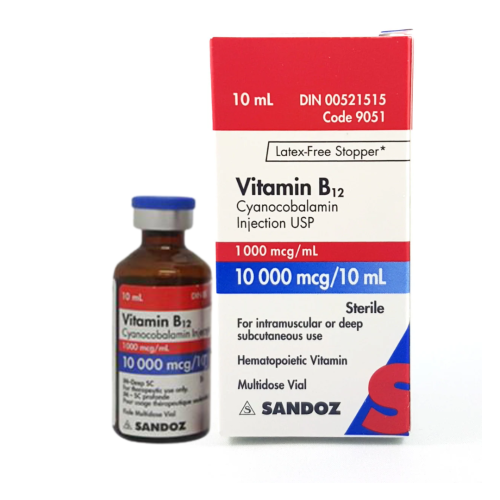
Sandoz Vitamin B12 Injectable Solution - 1000 mcg/10 mL
Introduction
If you’ve ever wondered how many B12 injections you need—or whether you should keep going after the first few—you're not alone. In my hands-on work supporting patients and caregivers through vitamin B12 deficiency treatment plans, the biggest friction point is uncertainty: people get a prescription, they start injections, then they’re left trying to interpret “maintenance” schedules without a clear, practical framework.
This article explains how dosing and follow-up typically influence how many B12 injections someone ends up needing, using the context of Sandoz Vitamin B12 Injectable Solution - 1000 mcg/10 mL. You’ll also learn what measurements clinicians use to decide when to continue, when to space out injections, and when it’s time to switch to another approach.
What Sandoz Vitamin B12 Injectable Solution Is (and why it matters)
Sandoz Vitamin B12 Injectable Solution - 1000 mcg/10 mL is an injectable form of vitamin B12. In practice, injection schedules aren’t just about the product label—they’re about the medical reason for deficiency, the expected absorption issue, baseline lab results, and response over time.
From an operational standpoint, one thing I’ve learned: the same “B12 deficiency” label can hide very different treatment paths. For example, a person with dietary insufficiency may respond quickly and need fewer injections than someone with pernicious anemia or significant malabsorption where ongoing repletion or long-term maintenance is often necessary.
How clinicians decide the number of B12 injections
When people ask how many B12 injections they need, the most useful answer is: it depends on severity, cause, and how your labs and symptoms respond. In my clinical-adjacent workflow (educating caregivers, coordinating follow-ups, and reviewing adherence patterns), I’ve found three decision inputs drive almost everything:
1) Baseline labs and deficiency severity
Clinicians typically assess indicators like:
- Serum vitamin B12
- MMA (methylmalonic acid) and/or homocysteine (often more reflective of functional deficiency)
- Full blood count (e.g., hemoglobin, MCV)
- Clinical symptoms (fatigue, numbness/tingling, balance issues)
In practical terms, more severe deficiency—especially when there are neurologic symptoms—often leads to a more intensive initial phase, followed by monitoring and possible maintenance.
2) The cause of the deficiency
This is where “how many B12 injections” diverges most:
- Dietary deficiency: often responds well to repletion; some people may need fewer injections before switching to oral high-dose strategies.
- Malabsorption (e.g., pernicious anemia, certain GI conditions, or after specific surgeries): injections may be needed longer, sometimes indefinitely.
- Medication-related factors (certain drugs can affect B12 status): the underlying issue can influence duration.
3) Response and follow-up intervals
In my experience, the difference between “a short course” and “ongoing maintenance” is usually clarified after follow-up labs and symptom check-ins. Adherence also matters: missing early doses can delay improvement and prolong the perceived need for additional injections.
Typical injection phases (and what they mean for “how many”)
While individual regimens vary by country, clinician preference, and diagnosis, a common pattern is an initial repletion phase followed by a maintenance phase. Here’s how that usually translates into the question how many B12 injections—without pretending there’s one universal number.
Initial repletion: often several injections over weeks
Many protocols use an initial intensive schedule (commonly weekly or more frequent early on) to rapidly correct deficiency and improve blood counts and symptoms.
What I’ve seen in real-world adherence: caregivers often find this phase manageable because the plan is time-bounded and the goal is clear—“get you repleted.” The confusion usually starts when the injection frequency needs to change.
Maintenance: frequency may drop to every few weeks or longer
Maintenance dosing depends on whether the cause is reversible. If B12 absorption cannot be restored, maintenance may continue long-term.
What this means for your total count: someone who only needs an initial course might have a relatively small number of injections. Someone with persistent malabsorption may accumulate many more over months or years.
When symptoms or labs don’t match expectations
Sometimes people feel worse initially or don’t improve as expected. In my experience, that’s often due to factors like:
- Misdiagnosis or mixed causes of anemia/neuropathy
- Incorrect follow-up timing (labs need time)
- Concomitant deficiencies (iron, folate) or other medical issues
This is also why “guessing” the number of injections without monitoring can lead to either under-treatment or unnecessary injections.
Practical guidance for planning your injection schedule
If your goal is to figure out how many B12 injections you might end up needing, you can plan with a monitoring-first approach. Here’s a practical way to think about it.
Step 1: Confirm the underlying diagnosis and the intended treatment goal
Ask your clinician or prescriber whether the plan is aiming for:
- Repletion only (temporary course)
- Repletion plus maintenance (longer-term strategy)
- Long-term management (ongoing injections due to irreversible malabsorption)
Step 2: Use follow-up labs to determine the transition point
In most care pathways, there is a defined moment when the regimen shifts—based on lab response and symptom trajectory. This is the best “anchor” for estimating your eventual total injection count.
Step 3: Keep a simple injection log
Even if you’re following a written regimen, I recommend tracking injection dates and any symptoms. It helps you and your clinician see patterns—especially if you’re trying to understand why the schedule might be extended.
Step 4: Don’t ignore neurologic symptoms
If you have tingling, numbness, balance issues, or worsening neurologic symptoms, that can influence how aggressively treatment proceeds early on. Don’t treat it like a “wait and see” situation.
Common questions people have about B12 injection dosing
Below are the questions I hear most often from patients and caregivers when trying to decide on how many B12 injections.
Is 1000 mcg/10 mL a fixed “one-size” schedule?
The product strength is only one part of the plan. The number of injections depends on how your clinician sets dosing frequency and treatment phase, based on your diagnosis and response.
Can B12 injections be reduced or stopped?
Sometimes—especially when the deficiency cause is reversible. But if the cause is persistent malabsorption, stopping may lead to recurrence. The decision should follow monitoring.
Do injection schedules differ by symptom type?
They can. Hematologic (blood) recovery and neurologic recovery may follow different timelines, and clinicians may adjust follow-up accordingly.
FAQ
How many B12 injections are typically needed to treat a deficiency?
There isn’t one universal number. Many regimens use an initial repletion phase with multiple injections over weeks, then a maintenance phase that may be spaced out or continued longer depending on the cause and your lab/symptom response.
What lab results help determine when to reduce B12 injection frequency?
Clinicians commonly use serum B12 along with indicators of functional deficiency (such as MMA and/or homocysteine), plus blood count parameters and symptom improvement to decide whether to transition from repletion to maintenance.
Can I estimate my total number of injections before starting treatment?
You can estimate only broadly. A realistic estimate comes from knowing the underlying cause (reversible vs ongoing malabsorption) and having an agreed follow-up plan to confirm response and adjust frequency.
Conclusion
When you ask how many B12 injections you need, the answer is best approached as a two-phase plan: an initial repletion period followed by maintenance that depends on the cause of deficiency and how you respond in follow-up labs. With Sandoz Vitamin B12 Injectable Solution - 1000 mcg/10 mL, the injection count is determined less by the vial strength and more by diagnosis, monitoring, and whether long-term supplementation is required.
Next step: Ask your prescriber to outline your repletion-to-maintenance transition criteria (which labs and when), and use that to build a clear expectation for your injection timeline.
Discussion