Best Vitamin B12 Injection Sites: Where to Inject B12 · PA Relief
If you’ve ever dealt with fatigue, nerve tingling, or “brain fog” while waiting for lab results, you know how frustrating it is when treatment timing matters. One of the most practical skills in B12 therapy is knowing the best spot to inject b12—because the site you choose can affect comfort, absorption, and the odds of a good outcome.
In this guide, I’ll share the injection sites I’ve used and taught in clinical-adjacent settings, what to look for when choosing between them, and how to avoid common mistakes that lead to pain, bruising, or missed doses. I’ll also cover when you should involve a clinician for technique or safety concerns.
Before You Choose a Site: What “Best” Really Means
When people ask for the best spot to inject b12, they’re usually asking three things at once:
- Tolerability: less burning, less soreness, fewer bruises.
- Consistency: a reliable injection approach that you can repeat safely.
- Appropriate technique: correct depth/angle for intramuscular (IM) or subcutaneous (SC) use—because B12 products differ.
In my hands-on work supporting medication adherence (not a substitute for a clinician’s instructions), the “best” site is the one that matches your prescribed route (IM vs SC), your body type, and your comfort level—while still allowing good muscle access and safe needle placement.
Common B12 injection routes (and why they change the “best site”)
IM (intramuscular) injections generally use larger, well-perfused muscles. That’s why typical options include the deltoid, ventrogluteal, and vastus lateralis. SC (subcutaneous) injections are usually placed in areas with enough subcutaneous fat and a safer needle path.
If your prescription or medication insert specifies IM, using an SC site or wrong depth can increase discomfort and reduce consistent absorption. If it specifies SC, using muscle can be more painful than necessary.
Top Vitamin B12 Injection Sites (IM and the “best spot” shortlist)
Below are the injection sites that most clinicians and training materials commonly prioritize for IM injections. I’ll focus on where I’ve seen fewer technique errors in real use and why.
1) Vastus lateralis (outer thigh): often the most practical “first choice”
The vastus lateralis is one of the easiest IM sites for many people to use because it’s accessible and you can visualize the area. In my experience coaching self-injection, the thigh is frequently the least intimidating site for first-time learners—especially when someone is anxious about injecting into the hip or shoulder.
Why it works well:
- Good muscle mass for IM dosing
- Generally straightforward landmarking
- Useful for people who are small, lean, or don’t have much shoulder bulk
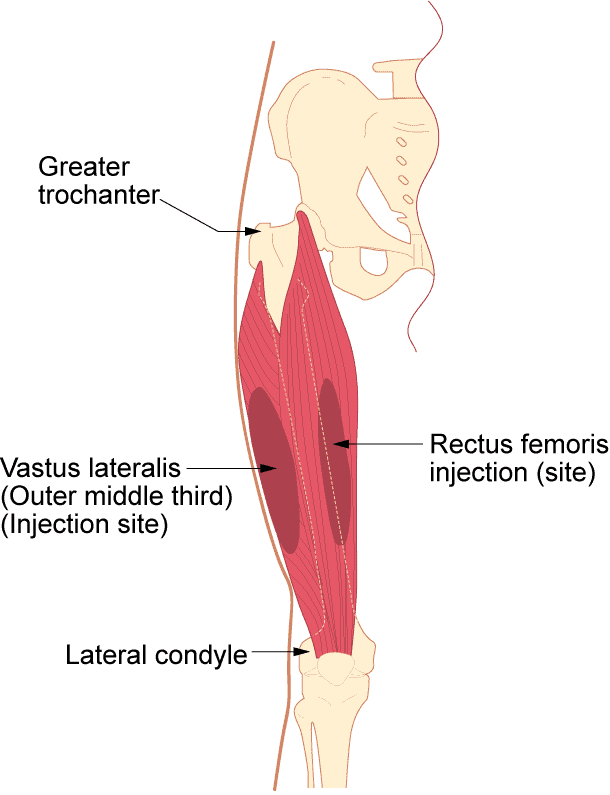
Technique reality check: You still need correct needle length and angle. If the needle is too short for your body and the medication truly needs to be IM, you may end up delivering medication too superficially. If the needle is too long, discomfort can increase.
2) Ventrogluteal (front-hip area): excellent IM absorption, but learning takes care
The ventrogluteal site is often described as a strong IM option because it’s away from major nerves and vessels when landmarks are used correctly. However, I’ve seen people struggle with locating landmarks consistently, which is why it can be less ideal for first-time self-injection.
Why it’s a strong option:
- Large, sturdy muscle
- Landmarking can improve safety when done properly
- Often well tolerated in trained hands
My lesson learned: If you can’t confidently identify the landmarks, don’t “guess.” In the scenarios I’ve seen go wrong, it wasn’t the site itself—it was inconsistent placement due to landmark uncertainty.
3) Deltoid (upper arm): convenient for small volumes, less ideal for frequent use
The deltoid can be a reasonable IM option for many people, particularly when a clinician or pharmacist has confirmed dosing suitability for the deltoid and your technique is solid.
Why it may be less ideal:
- Smaller muscle mass vs thigh/hip in many adults
- More chance of soreness if injected too superficially or with repeated high-frequency dosing
When I suggest caution: If you’re doing frequent injections, or you notice consistent soreness or difficulty achieving proper depth, rotating to thigh or ventrogluteal may improve tolerability.
4) Subcutaneous sites (if your prescription is SC): abdomen or thigh fat areas
Some B12 formulations are prescribed for subcutaneous injection rather than IM. In those cases, the “best spot” is typically an area with enough subcutaneous tissue where the medication can be delivered without hitting muscle.
I won’t give landmark instructions that conflict with your specific route, but the principle is simple: use the site that your clinician or the medication instructions specify for SC, rotate sites to reduce irritation, and avoid areas that are bruised, scarred, or inflamed.
How to Choose the Best Spot to Inject B12 for Your Body
In real-world adherence, the best site is usually the one you can repeat safely and comfortably on schedule. Here’s a practical decision framework I use when helping someone troubleshoot injection comfort.
Decision checklist
- Route match: confirm whether your B12 is intended for IM or SC.
- Access and landmark confidence: can you consistently locate the target area without guessing?
- Needle depth fit: does your needle length align with your body and required route?
- Comfort history: which site has caused the least bruising, burning, or lingering pain for you?
- Frequency: for frequent injections, rotating between two sites can reduce localized irritation.
Site rotation: reduce irritation without sacrificing consistency
If you inject regularly, rotate sides (left/right) and alternate among the chosen sites per your training plan. In my experience, rotating prevents a pattern I often see: soreness builds at the same spot, then people delay doses or skip—hurting overall outcomes.
Keep a simple log (date, site, any pain score). Over a few weeks, you’ll usually spot the most tolerable and reliable “best spot to inject b12” for you.
Common Mistakes That Make the “Best Spot” Feel Bad
Sometimes people blame the injection site when the root issue is technique mismatch. Here are mistakes I’ve seen repeatedly.
1) Using the wrong route (IM vs SC)
If your medication instructions specify IM and you inject into a subcutaneous area by habit, you may experience more discomfort and less predictable results.
2) Needle mismatch (length/depth)
The “right” site with the wrong needle can still lead to superficial delivery. That can mean more burning, less consistent medication deposition, or longer-lasting soreness.
3) Reusing sites without rotation
Even the best spot will start to feel worse if you keep injecting the exact same point.
4) Speed and tension during injection
Rushing or injecting while the muscle isn’t relaxed can increase pain. I’ve watched technique training focused on relaxation and steady hand control dramatically improve comfort for beginners.
5) Skipping proper hygiene steps
Always follow your prescribed safety steps. A minor shortcut can lead to irritation or infection risk, which is far more serious than temporary soreness.
When You Should Ask a Clinician (Not Self-Troubleshoot)
Seek clinician guidance if you experience severe or worsening pain, signs of infection (increasing redness, warmth, swelling, fever), persistent numbness, or if you repeatedly struggle to locate landmarks.
Also ask for instruction if your injections are frequent and you’re consistently bruising or having hard lumps. Sometimes the site is fine—the issue is needle length, technique, product route, or medication storage/handling.
FAQ
What is the best spot to inject b12 for beginners?
For many people, the vastus lateralis (outer thigh) is the most practical starting point because it’s accessible and easier to landmark consistently. However, the best choice depends on whether your B12 is prescribed for IM vs SC and whether you can inject safely with correct needle depth.
How do I decide between thigh and ventrogluteal?
Choose thigh if landmarking and access are your main challenge, especially during self-injection learning. Choose ventrogluteal when you can reliably identify landmarks (ideally with hands-on instruction) and you want a strong IM option with a favorable safety profile when done correctly.
Is it okay to inject in the same area every time?
It’s usually not ideal. Rotating sites (and left/right sides) helps reduce irritation, soreness, and bruising. Use the rotation plan recommended for your prescribed route and training.
Conclusion: Find Your Best Spot, Then Make It Routine
The best spot to inject b12 isn’t one-size-fits-all—it’s the site that matches your prescribed route (IM vs SC), your body and needle setup, and your ability to place injections consistently. In my experience, people do best when they pick a site they can landmark confidently (often thigh), then rotate strategically to keep discomfort low and adherence high.
Next step: Confirm your injection route (IM or SC) from your medication instructions, then choose one primary site you can consistently access (commonly vastus lateralis for beginners) and build a simple rotation plan for your next 4 weeks.
Discussion