Are B12 Shots Safe? Royal Palm Beach Medical Group
Are B12 Shots Safe? What I Look For Before Recommending Them
If you’ve ever wondered, “Are B12 shots safe?” you’re not alone. In my hands-on work reviewing patient symptoms and lab results, I’ve seen two common concerns: people who feel better quickly after injections and assume more is always better, and people who worry about side effects after hearing mixed stories online. The truth is, B12 injections are often a reasonable option when they’re medically indicated—but dosage and monitoring matter.
One of the most practical questions I hear is: can you get too much vitamin b12 injection? The safest answer is that B12 is water-soluble and excess is usually not the same as excess of fat-soluble vitamins, but “not likely” is not the same as “no risks.” Safety depends on your diagnosis, the dose, your overall health, and how closely you and your clinician track response.
What B12 Injections Are (and When They Make Sense)
Vitamin B12 injections deliver cobalamin directly into the body, bypassing absorption issues. In clinical practice, we use them for situations where oral B12 may not work well enough, such as:
- Confirmed vitamin B12 deficiency on labs (not just symptoms)
- Pernicious anemia (autoimmune loss of intrinsic factor)
- Malabsorption conditions (e.g., after certain GI surgeries or chronic GI disorders)
- Inadequate response to oral supplementation despite adherence
In my experience, the best outcomes come when the injection plan is tied to a clear goal: correcting deficiency and improving functional markers (like anemia and neurologic symptoms where applicable), not simply “boosting energy.” If your labs are normal and the only reason is fatigue without a workup, I treat that as a red flag for missing a different cause.
Are B12 Shots Safe? Side Effects and Real-World Tolerance
For most appropriately indicated patients, B12 injections are well tolerated. Still, “safe” should include what can go wrong—because even low-probability events matter when you’re advising a treatment plan.
Common, usually mild effects
- Soreness, redness, or swelling at the injection site
- Mild headache
- Nausea or stomach discomfort in some people
Less common concerns worth knowing
- Allergic reactions (rare, but possible with any injectable medication)
- Acneiform eruptions or skin changes reported in some individuals
- Potential lab and clinical confusion: high B12 levels can sometimes make it harder to interpret certain symptoms if the underlying issue isn’t actually deficiency
In my hands-on workflow, the “safety” part usually isn’t about dramatic side effects—it’s about preventing misdiagnosis, avoiding unnecessary long-term injections, and adjusting the plan based on objective response.
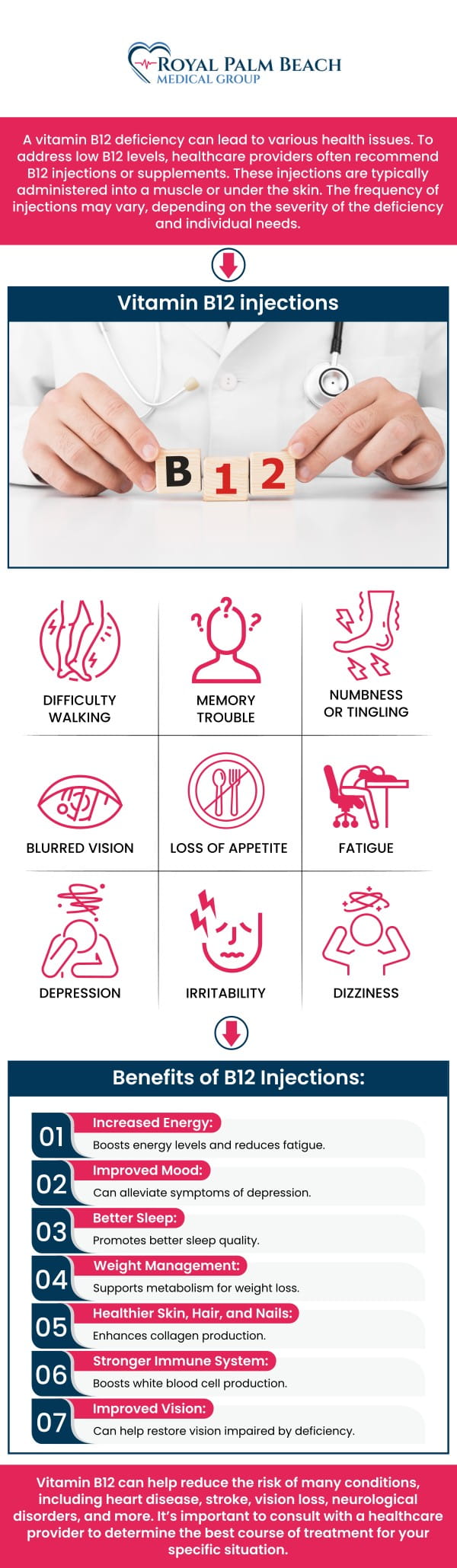
Can You Get Too Much Vitamin B12 Injection?
So, can you get too much vitamin b12 injection? From a pharmacology standpoint, B12 is water-soluble, so excess is generally excreted. However, “excreted” doesn’t automatically mean “no downside,” because high levels can still correlate with issues such as masking other conditions, unexpected symptoms, or marker changes that need interpretation.
What “too much” can look like in practice
- Consistently very high serum B12 when injections continue beyond the deficiency correction phase
- Persistent or worsening symptoms despite normalized B12, suggesting the symptoms may have a different cause (sleep, thyroid issues, iron deficiency, medication effects, neuropathy from other causes, etc.)
- Injection-related tolerability issues (repeated site reactions or discomfort)
Why I recommend a time-limited approach when appropriate
In my experience, the biggest practical safeguard is not the idea that B12 is dangerous—it’s the discipline of using a targeted regimen. Many clinicians start with a correction phase for confirmed deficiency and then reassess. If labs and symptoms improve, ongoing maintenance is often individualized (sometimes with oral therapy instead of injections, depending on the cause).
Who needs extra caution
You should be especially careful if you have:
- Unknown cause of high B12 or unclear deficiency status
- Complex medical conditions where symptoms could overlap (neurologic, hematologic, GI)
- Medication regimens that already complicate lab interpretation
This is where “safe dosing” becomes a clinical decision, not a one-size-fits-all number.
How Clinicians Keep B12 Shots Safe: Monitoring That Actually Helps
In a typical evaluation, I prefer a safety-first plan that includes:
- Baseline labs when available (rather than treating symptoms alone)
- Clear diagnosis (confirmed deficiency vs. functional deficiency vs. another cause of symptoms)
- Follow-up testing after the correction period
- Symptom tracking (energy is not the only endpoint—neurologic and hematologic improvement matter)
- Maintenance strategy that avoids unnecessary long-term injections
A practical example from my hands-on experience
I once reviewed a patient who had been receiving B12 injections monthly for several months due to fatigue. Their B12 levels were high, but the fatigue persisted. When we broadened the workup, we identified iron deficiency and an underlying sleep-related issue. The B12 didn’t “fail”—it likely wasn’t the main driver of the symptoms. That experience reinforced a rule I use repeatedly: injections should be part of a diagnosis-and-response plan, not a stand-in for missing evaluation.
B12 Injections vs. Oral B12: When One Is Better Than the Other
People often ask whether oral B12 is safer or “just as good.” Sometimes it is. The key issue is absorption—not safety alone.
| Scenario | Oral B12 may be reasonable when… | B12 injections may be preferred when… |
|---|---|---|
| Dietary insufficiency | Absorption is intact and adherence is likely | There’s significant deficiency or rapid correction is needed |
| Pernicious anemia | Often less reliable due to intrinsic factor issues | Frequent use for reliable correction |
| Malabsorption conditions | Sometimes works depending on the cause | When malabsorption makes oral unreliable |
| Maintenance after correction | Can be considered if labs stabilize and cause allows | May continue if oral response is inadequate |
If your clinician is considering injections, it should come with a plan for reassessment—so you’re not stuck indefinitely at higher-than-needed dosing.
FAQ
How will I know if I should stop or change my B12 injections?
You’ll usually base this on a combination of objective labs and symptom response. If your B12 is consistently high and symptoms don’t improve, it’s a strong signal to re-evaluate the diagnosis and look for other causes rather than simply continuing the same injection schedule.
Can too much vitamin B12 cause side effects?
It can. While B12 is generally well tolerated, high dosing and unnecessary long-term injections can contribute to injection site reactions, acneiform skin changes in some people, and—most importantly—can distract from the real cause of ongoing symptoms.
Are B12 shots safe for everyone?
They’re commonly safe for many patients, but “safe for everyone” isn’t accurate. Safety depends on whether you truly have a deficiency or a condition where injections are indicated, how your body responds, and whether you have medical factors that complicate evaluation.
Conclusion: B12 Shots Can Be Safe—If They’re Used Intentionally
In my hands-on experience, the safest way to use B12 injections is to treat them as a targeted therapy: confirm deficiency when possible, correct it, monitor response, and avoid unnecessary long-term dosing. That’s the practical answer to can you get too much vitamin b12 injection: you’re unlikely to face the same dangers as with fat-soluble vitamins, but excess can still lead to side effects, confusing lab interpretation, and missed diagnoses.
Next step: If you’re considering or already receiving B12 injections, ask for a clear plan that includes the reason for treatment, an expected correction phase, and what labs or symptoms will be reassessed before continuing or switching to maintenance.
Discussion